

Discover Artists from Your Music Era: A Complete Guide
July 2, 2026
Discover Artists from Your Music Era: A Complete Guide
Discovering artists from your music era means using era-specific chart data, curated decade playlists, and artist similarity networks to find both famous and overlooked musicians from the years that shaped your taste. The process goes well beyond typing a decade into a search bar. Tools like 88mph, Apple Music’s decade essentials playlists, and Top40Weekly give you fixed historical anchors to work from. Combine those anchors with modern recommendation engines, and you get a discovery experience that feels personal, not random.
How to discover artists from your music era using chart snapshots
Era-specific charts are the most reliable starting point for music discovery. They give you a ranked, culturally grounded list of what people were actually listening to in a given year and country.
88mph covers 329 charts across 33 countries from 1940 to 2025, each with a ranked top 10 and a short cultural context blurb. That context matters. Knowing that a 1983 UK chart was dominated by synth-pop while the US leaned toward arena rock tells you something about the artists on each list before you hear a single note.
Here is a simple process to get started:
- Choose your target year and country. Be specific. “The mid-90s” is too broad. “US, 1994” gives you a concrete pool of artists.
- Pull up the top 10 chart for that year. Note which artists appear more than once across adjacent years. Repeat appearances signal era-defining careers, not one-hit wonders.
- Read the cultural context blurb. It connects chart positions to real events, which helps you understand why certain artists dominated.
- Cross-reference the list against artists you already love. If three of your favorites appear, the remaining seven are worth investigating.
Top40Weekly takes a more personal angle. Its birthday song tool shows you the number one song during your birth week, using historical US Top 40 data. That single data point can anchor an entire era of discovery.
| Tool | Coverage | Best Use |
|---|---|---|
| 88mph | 33 countries, 1940–2025 | Country and year-specific top 10 charts |
| Top40Weekly | US Top 40, historical | Personal date anchors and nostalgic hits |
| Apple Music playlists | Decade-based, genre-filtered | Broad era immersion with editorial curation |

Pro Tip: Read the cultural context blurbs on 88mph before you listen. They prime your ear for the era and make the music land differently than it would cold.
What curated decade playlists reveal that charts miss
Charts show you what sold. Playlists show you what lasted. The difference is significant when you want to find artists from your decade who shaped a genre without necessarily topping the pop charts.
Apple Music’s 2010s Indie Essentials playlist contains 100 songs totaling over 7 hours of music. That scale means you encounter artists who never cracked the mainstream but defined the sound of a generation for millions of listeners. Artists like Alex G, who built a devoted following through lo-fi bedroom recordings, appear in genre-focused decade playlists long before they show up on any pop chart.
Large playlists also surface hidden gems through sheer volume. When you listen to 100 tracks from a single decade, patterns emerge. You start hearing which producers, labels, and regional scenes kept appearing. That pattern recognition is how serious music fans find artists from their youth that they missed the first time around.
- Filter by genre first. A 2000s hip-hop essentials playlist and a 2000s rock essentials playlist will share almost no artists. Genre filtering prevents era drift and keeps your discovery focused.
- Track time commitment. A 7-hour playlist is not a single sitting. Treat it like a catalog. Return to it across multiple sessions and mark artists who catch your attention.
- Note the outliers. The tracks that feel slightly out of place in a decade playlist are often the most interesting. They signal an artist who was ahead of or behind the dominant sound.
- Cross-reference with charts. When a playlist artist does not appear on any chart from their era, that is a strong signal you have found a genuine hidden gem.
Pro Tip: Build a running list of artists you want to investigate further as you move through a decade playlist. Do not stop to research mid-listen. Capture the name and come back to it.
How do artist similarity graphs help you find musicians from your era?
Artist similarity graphs are the underlying technology behind most modern music recommendations. Platforms like Spotify and Last.fm build networks weighted by co-listening data, meaning artists that people frequently listen to together end up positioned close to each other in the graph. That proximity drives the “fans also like” recommendations you see on every major platform.
The practical value for era-based discovery is significant. If you seed a similarity engine with three artists from 1991, the related artist suggestions will cluster around that period naturally. The co-listening data reflects real listening behavior from real fans of that era.
“Combining chart anchors with taste anchors creates stronger and more personalized era-based music discovery results.” — NetworkingGuru Music Discovery
Similarity engines also improve over time. A seed-to-feedback loop works like this: you provide seed artists, the engine builds a recommendation set, you listen and mark favorites, and the engine refines its next batch. After two or three rounds, the suggestions become noticeably more accurate.
A few things to keep in mind when using similarity graphs for era discovery:
- Anchor with era-specific seeds. Start with artists you know are from your target decade. Seeding with a contemporary artist and hoping for 90s results will not work.
- Use multiple platforms. Spotify, Last.fm, and Music-Map each weight their graphs differently. Running the same seed artists through all three surfaces different adjacent musicians.
- Watch for era drift. Similarity graphs do not respect decade boundaries. An artist from 2005 might appear in a 1995-seeded graph because their sound is derivative of that era. Decade filters applied before similarity expansion prevent this drift.
- Add thematic tags. Tools that use folksonomy-based tags like “melancholy,” “post-punk,” or “urban” push recommendations toward emotional and lyrical coherence, not just sonic similarity.
What is the best step-by-step process to find artists from your decade?
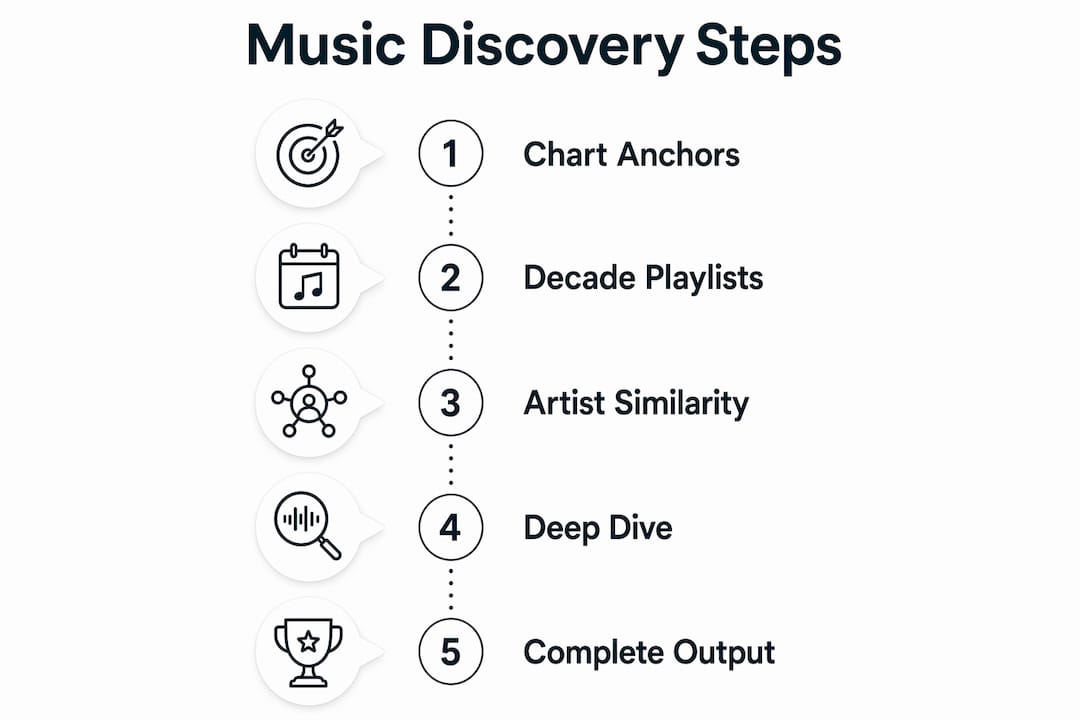
The most effective discovery workflow combines chart anchors, curated playlists, and similarity engines in a specific sequence. Each method compensates for the weaknesses of the others.
- Start with a chart anchor. Pick a specific year and country. Pull the top 10 from 88mph. These are your era anchors. They are historically verified and culturally grounded.
- Expand with a curated playlist. Find a decade-specific playlist on Apple Music or a comparable platform filtered to your target genre. Add any new artists to your investigation list.
- Seed a similarity engine. Take your five strongest artists from steps one and two and run them through Spotify’s related artists feature or Last.fm’s similar artists tool. Note which suggestions fall within your target decade.
- Apply thematic filters. If your era had a specific emotional character, use tag-based tools to push recommendations toward that theme. This step surfaces artists that sound and feel like your era, not just artists who were popular at the same time.
- Listen and give feedback. Mark the artists that resonate. Use that feedback to run another round of similarity recommendations. Splitting discovery into chart-based picks and thematic expansions prevents you from cycling through the same top hits repeatedly.
The most common mistake is skipping the anchor step and going straight to similarity recommendations. Without a concrete era anchor, the engine has no fixed point to work from and the results drift toward whatever is currently popular.
| Method | Strength | Weakness |
|---|---|---|
| Chart snapshots | Historically accurate, culturally grounded | Misses non-charting artists |
| Curated playlists | Broad coverage, genre-filtered | Editorial bias, time-intensive |
| Similarity graphs | Personalized, adaptive | Era drift without decade filters |
Pro Tip: Run your final artist list through the Arteest artist catalog to see each musician’s full chronological career. Knowing an artist’s complete output changes how you hear their era-defining work.
Key Takeaways
The most effective way to find artists from your decade is to anchor on verified chart data first, then expand through curated playlists and similarity networks filtered to your target era.
| Point | Details |
|---|---|
| Start with chart anchors | Use tools like 88mph to pull verified top 10 lists by year and country before exploring further. |
| Use decade playlists for depth | Curated playlists like Apple Music’s 2010s Indie Essentials surface artists that charts consistently miss. |
| Apply similarity graphs carefully | Seed engines with era-specific artists and apply decade filters to prevent recommendations from drifting outside your target period. |
| Add thematic tags | Folksonomy-based tags like “post-punk” or “melancholy” push discovery toward emotional coherence, not just sonic similarity. |
| Combine all three methods | Chart picks, playlist gems, and similarity suggestions together produce a more complete and personal era discovery than any single method alone. |
Why I think most music fans are doing era discovery backwards
Most music fans start with a feeling. They want to feel like it is 1995 again, so they search “best 90s songs” and end up with the same 20 tracks they already know. That approach is backwards. You are asking a search engine to confirm what you already remember instead of asking it to show you what you missed.
The more productive instinct is to treat your era like a foreign country you have only visited once. You know the major landmarks. What you do not know is the neighborhood music, the local artists, the B-sides that never made it to the tourist map. Chart data gives you the landmarks. Curated playlists give you the neighborhoods. Similarity graphs give you the locals.
I have found that the most satisfying discoveries come from artists who were active during my target era but operated one level below the mainstream. They had the sound of the period without the overexposure. Hearing them now feels like finding a record you should have owned for 30 years. That feeling is the whole point of era-based discovery, and it only happens when you go past the obvious hits.
The technology available now makes this easier than it has ever been. The challenge is not access. The challenge is discipline. Stay anchored to your era, apply filters before you expand, and resist the pull of the algorithm toward whatever is trending today.
— Jorel
Arteest is built for this kind of music exploration
Arteest is a premium music discovery platform with thousands of artists, bands, record labels, producers, and engineers, each with their own page showing their full career in chronological order. For music fans doing era-based discovery, that structure is exactly what you need.
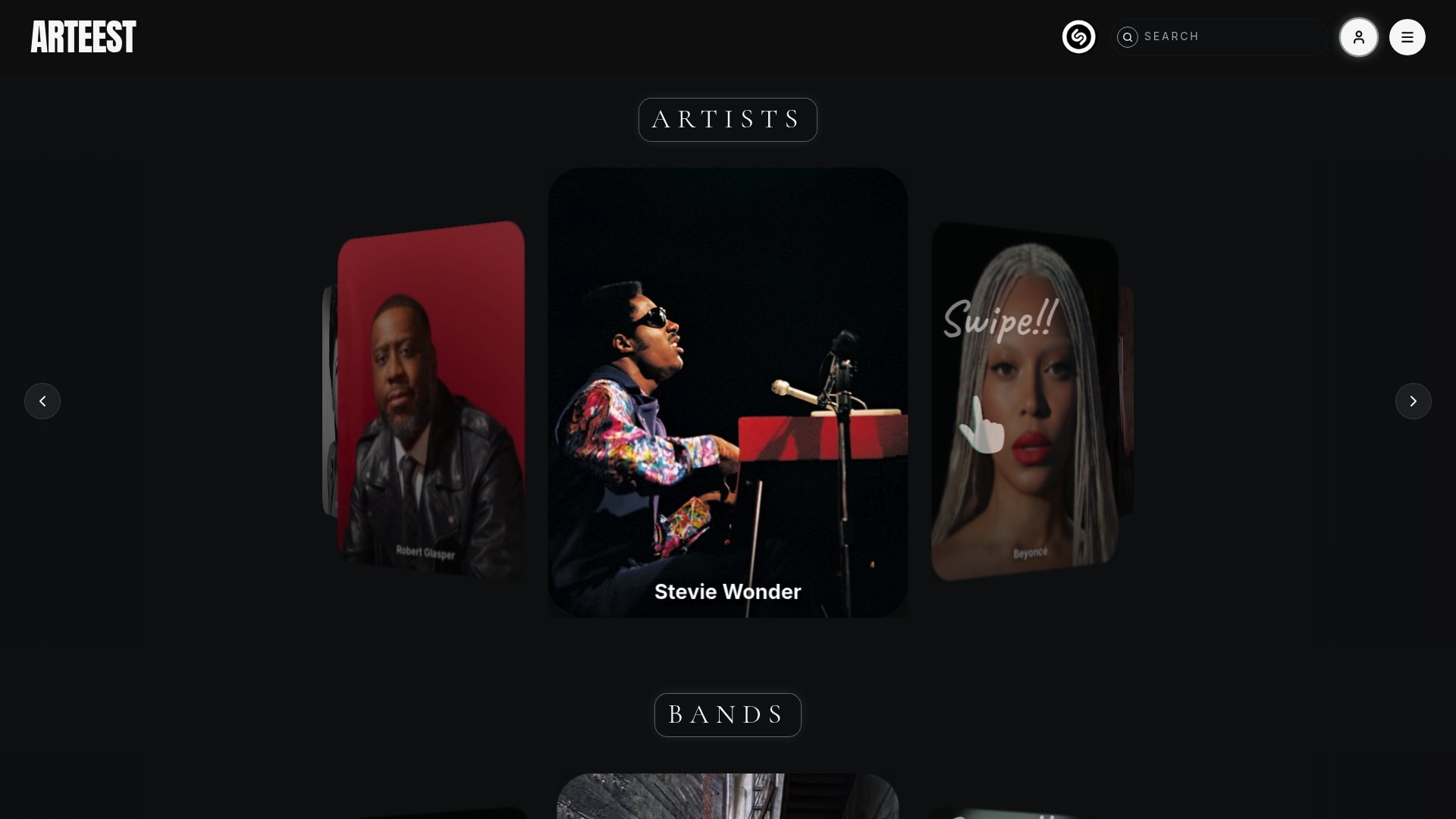
When you find an artist through a chart snapshot or a decade playlist, Arteest lets you see their complete output in one place, from their earliest recordings to their final releases. You can browse by genre to stay within your target era, or pull up the full artist catalog and filter by decade. Personal profile pages let you build collections and bins of your favorite artists, create shareable lists, and export them as PNG or MOV files to send directly to friends or post to social media. Arteest turns a discovery session into a permanent, shareable record of your musical taste.
FAQ
What does it mean to discover artists from your music era?
Era-based music discovery means using chart data, curated playlists, and similarity tools to find both well-known and overlooked artists from a specific decade or period. The goal is to move beyond familiar hits and uncover musicians who defined the era’s sound.
Which tools are best for finding artists from a specific decade?
88mph provides ranked top 10 charts for 33 countries from 1940 to 2025. Apple Music’s decade essentials playlists and Top40Weekly’s historical chart data are also strong starting points for era-focused discovery.
How do artist similarity graphs work for era discovery?
Platforms like Spotify and Last.fm build similarity networks weighted by co-listening behavior. Seeding these engines with era-specific artists and applying decade filters produces recommendations that stay within your target period.
What are the best artists from the 90s to use as discovery seeds?
Artists who defined a genre rather than just topped the charts make the strongest seeds. Seeding with Nirvana, A Tribe Called Quest, or Massive Attack produces a wider and more interesting set of related artists than seeding with the decade’s biggest pop acts.
How do I avoid getting the same popular hits every time I search?
Split your discovery into two tracks: chart-based picks for verified era hits and thematic or similarity-based picks for emotional and genre coherence. Combining both tracks surfaces unexpected artists and breaks the repetitive top-hits loop.