

How Music Taste Expansion Works: A Science Guide
July 2, 2026
How Music Taste Expansion Works: A Science Guide
Music taste expansion is defined as the brain’s learned process of updating auditory preferences through repeated exposure, emotional context, and neurological reward signals. Understanding how music taste expansion works gives you a real advantage: instead of waiting for new genres to “click,” you can actively shape the conditions that make them click faster. The science behind this process draws on neuroscience, psychology, and social identity research, and it explains why the jazz album you dismissed last year might be your favorite by next spring.
How music taste expansion works in the brain
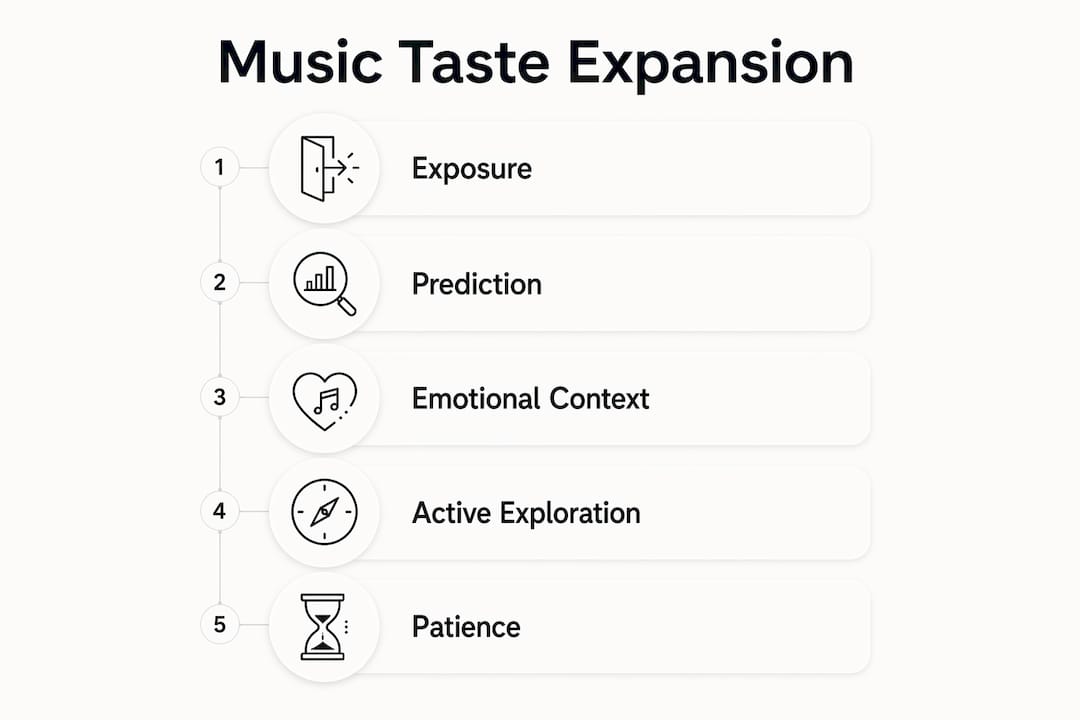
Your brain is a prediction machine. Every time you hear music, it forecasts what comes next based on patterns it already knows. When the music surprises it, a signal called a reward prediction error fires. Musical preferences are learned through exactly this mechanism: the brain detects a mismatch between what it expected and what it heard, then updates its emotional response accordingly. Over time, what once sounded foreign starts to sound familiar, and familiar starts to sound good.
This is where the mere-exposure effect becomes critical. Research validated since the 1970s shows that 8–12 passive exposures can shift a song from “annoying” to “catchy” without any conscious effort on your part. That number is surprisingly low. You do not need to study a genre or read about it. You just need to hear it enough times in low-pressure settings.

Dopamine plays a direct role in this shift. As your brain learns the patterns of a new genre, the dopamine response changes from a spike at the moment of surprise to a more sustained, pleasurable anticipation. That is the neurological signature of genuine taste formation. You are not just tolerating the music anymore. You are enjoying the act of predicting it.
Key mechanisms driving this process:
- Reward prediction error: Unexpected sounds trigger learning updates in the brain’s reward circuit.
- Mere-exposure effect: Passive repeated listening reduces novelty anxiety and builds familiarity.
- Dopamine adaptation: Sustained dopamine release replaces initial surprise spikes as patterns become recognizable.
- Auditory syntax learning: The brain builds a grammar for new genres the same way it learns language rules.
Pro Tip: Apply the “skip rule” when exploring new music. Research shows that skipping a track repeatedly is actually part of the brain’s engagement process. Do not delete a skipped song from your playlist. Leave it there. The repeated partial exposure still counts toward familiarization.
Why emotional memory makes music taste so hard to change
The neuroscience of exposure explains how taste can change. The psychology of emotional memory explains why it often does not. Music taste development is deeply tied to who you were when you first fell in love with sound.
Researchers call this the “reminiscence bump.” Music from adolescence and early adulthood is neurologically encoded with stronger emotional and identity markers than music encountered later in life. This is not nostalgia. It is biology. During identity formation, the brain is more plastic and more emotionally reactive, so the music from that period gets wired in at a deeper level.
This creates a real tension in music taste expansion. Your existing favorites are not just preferences. They are part of how you understand yourself. Introducing a new genre feels, at a subconscious level, like a small identity challenge. That resistance is normal, and knowing it exists is the first step to working around it.
Emotional mechanisms that shape music preference include:
- Autobiographical memory: Songs tied to specific life events carry emotional weight that generic new music cannot immediately match.
- Identity reinforcement: Listening to familiar genres signals group membership and self-concept consistency.
- Mood congruence: People gravitate toward music that matches their current emotional state, limiting exposure to contrasting styles.
- Context dependency: The same song heard in a different setting, a concert versus a grocery store, can trigger completely different emotional responses.
The practical implication is clear. If you want to accept new music, you need to give it emotional context. Hearing a genre cold, with no story and no personal connection, puts it at a massive disadvantage against music that already carries years of memory. This is why music taste is linked to identity in ways that adults find genuinely hard to override without deliberate strategy.
Does active exploration beat passive listening for expanding genres?
Passive listening works, but active, narrative-driven exploration works faster and reaches further. The key concept here is “taste-broadening serendipity,” which researchers define as the pleasant surprise of discovering music you would not have chosen on your own. The strongest predictor of this outcome is not knowing facts about an artist. It is being transported into a story about them.
Studies show that immersive narrative introductions increase openness to unfamiliar music more effectively than cognitive elaboration or artist biography facts. Transportation, the psychological state of being absorbed in a story, lowers your evaluative defenses. When you are inside a narrative about how Art Farmer developed his flugelhorn sound in 1950s New York, you are not judging the music as a stranger. You are hearing it as part of a world you already care about.
This is why soul music transcends age groups so reliably. The genre carries inherent storytelling. Its emotional directness creates a narrative entry point that bypasses the usual resistance to unfamiliar sounds.
Practical ways to apply narrative immersion in your own discovery process:
- Read a musician’s biography or watch a documentary before listening to their catalog.
- Follow a genre’s historical arc chronologically, starting with its roots, so each new sound feels like a logical next chapter.
- Listen to albums tied to specific cultural moments, the Harlem Renaissance, the British Invasion, the rise of Detroit techno, as historical artifacts rather than abstract music.
- Use artist pages that show a career timeline so you understand where each record fits in a larger story.
Pro Tip: Human curation beats algorithmic curation for taste expansion. A friend’s recommendation carries narrative context (“this reminds me of what you said about X”) that an algorithm cannot replicate. Seek out curated playlists built by people, not by engagement metrics.
Gradual discovery vs. algorithmic echo chambers: which actually expands taste?
The method you use to discover music shapes the music you end up liking. This is one of the most underappreciated factors in music taste expansion, and the research is direct about the difference between approaches.
Incremental, feedback-driven discovery with small steps into unfamiliar genres produces better long-term taste expansion than sudden genre switching or passive algorithmic listening. The reason is neurological. Small steps keep the prediction error system engaged without overwhelming it. Each slightly unfamiliar song updates your preferences by a small degree. Compound those updates over weeks and months, and you end up somewhere genuinely new.
Algorithmic recommendation systems work against this process at scale. Structural barriers on platforms restrict music diversity once a conformity threshold is reached, reinforcing existing preferences rather than challenging them. The algorithm reads your engagement signals and serves more of what already works. That is good for retention. It is bad for growth.
| Approach | Mechanism | Taste expansion outcome |
|---|---|---|
| Passive algorithmic listening | Platform serves familiar-adjacent content | Slow narrowing of preferences over time |
| Sudden genre switching | High novelty, low familiarity | Rejection and disengagement |
| Gradual, feedback-driven discovery | Small steps with user input | Sustained, measurable taste broadening |
| Narrative-immersive exploration | Story context lowers evaluative resistance | Faster acceptance of unfamiliar genres |
| Human-curated playlists | Social and contextual framing | Higher openness and emotional connection |
The table above makes the pattern clear. Passive listening and sudden jumps both underperform. The approaches that work share two features: they are gradual, and they provide context. Algorithms optimize for what you already like. Taste expansion requires optimizing for what you do not like yet.
Algorithmic echo chambers are not a conspiracy. They are a design consequence. Platforms built around engagement will always trend toward comfort. Breaking out requires deliberate effort, which is exactly what the gradual discovery model provides.
Key takeaways
Music taste expansion works through a combination of neurological learning, emotional context, and deliberate exposure strategy, not through passive hope or random discovery.
| Point | Details |
|---|---|
| Mere-exposure effect drives change | 8–12 passive listens can shift a song from disliked to genuinely enjoyed. |
| Narrative immersion accelerates acceptance | Story-based introductions to artists lower resistance faster than facts alone. |
| Adolescent music is neurologically anchored | Identity formation makes early favorites hard to displace without conscious strategy. |
| Gradual discovery outperforms algorithms | Small, incremental steps into new genres produce better long-term taste growth. |
| Emotional context is the missing variable | New music needs personal or narrative context to compete with memory-laden favorites. |
Why patience is the real skill in expanding your music taste
I have spent years watching people try to expand their musical horizons and give up after two listens. The pattern is always the same: they hear something unfamiliar, feel nothing, and conclude it is not for them. That conclusion is almost always wrong. It is just premature.
The research backs this up. Instant liking is rare, and impatience is the single biggest barrier to taste expansion. Most listeners abandon a song or genre before the mere-exposure effect has had any chance to work. They are essentially quitting a language class after the first lesson and concluding they have no talent for languages.
What I have found actually works is treating initial indifference as neutral data, not negative feedback. When a record feels underwhelming on first listen, that is not the record failing. That is your brain encountering an unfamiliar syntax. Give it time. Come back to it in a different mood, a different setting, a different week. The emotional readiness you bring to a listening session matters as much as the music itself.
The other thing I would push back on is the idea that you need to abandon your existing taste to grow. Your current favorites are the best entry points you have. If you love the guitar work in classic rock, jazz guitar is one small step away. If you are drawn to lyrical density in hip-hop, spoken word poetry and singer-songwriter folk are natural bridges. Taste expansion is not a rejection of who you are. It is an extension of it.
— Jorel
Start exploring with Arteest
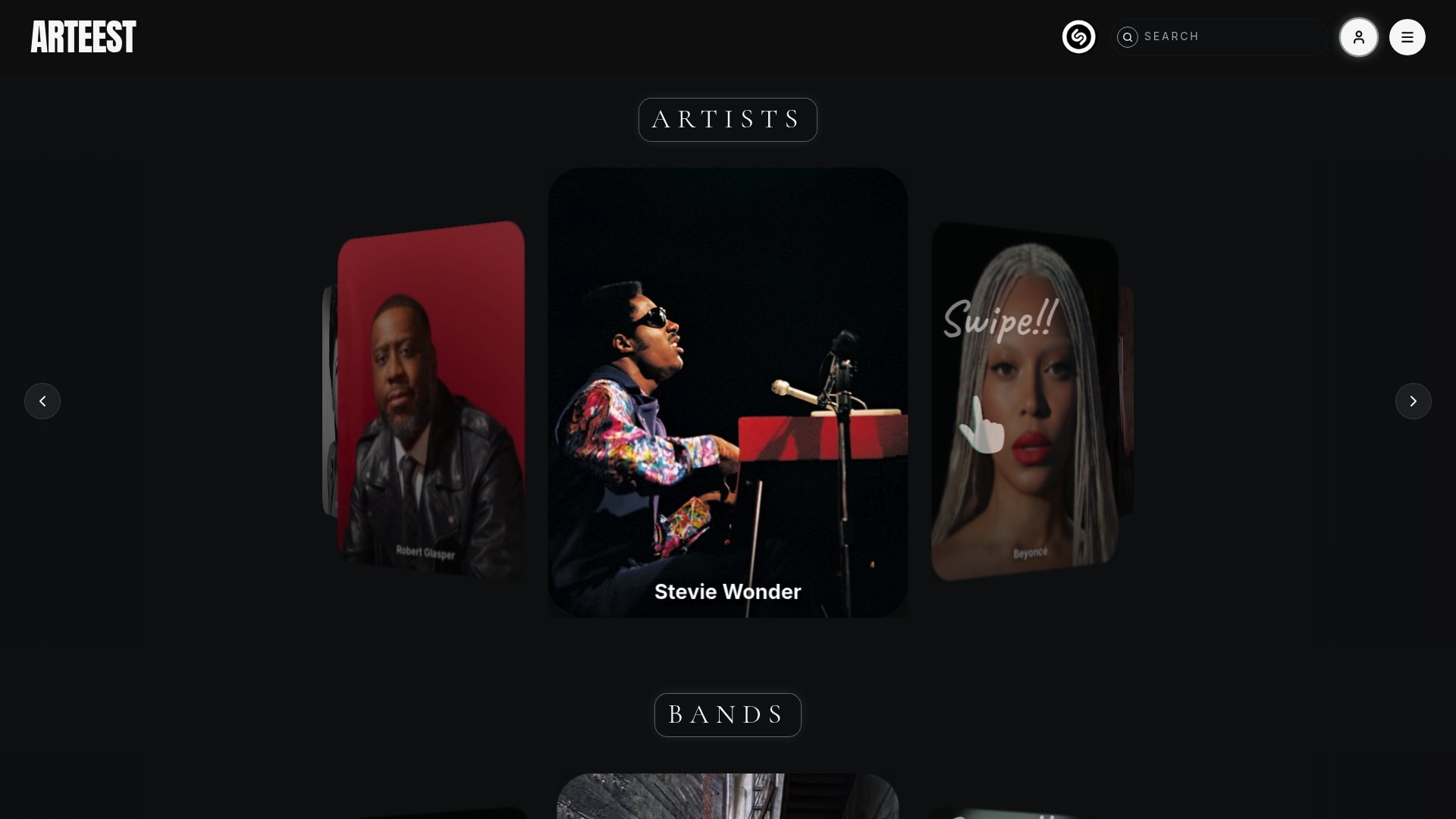
Arteest is built for exactly the kind of deliberate, narrative-driven music discovery this article describes. Every artist, band, record label, producer, and engineer on the platform has a dedicated page showing their full career chronologically. That timeline context is the story-based entry point that research shows accelerates taste expansion. You can browse all genres to find your next small step into unfamiliar territory, or discover new artists through curated pages that give you the career arc before you commit to a single listen. Build your own collections, create shareable lists, and send them directly to friends as PNG or video files. Start exploring on Arteest and put the science of taste expansion to work.
FAQ
How many times do you need to hear a song to like it?
Research on the mere-exposure effect shows that 8–12 passive exposures are enough to shift a song from disliked to genuinely enjoyable. The listens do not need to be intentional or focused.
Why is it hard to like music outside your usual genres?
Your brain has built a prediction model based on familiar musical patterns. Unfamiliar genres violate those predictions, which initially feels uncomfortable. Repeated exposure gradually updates the model until the new patterns feel natural.
Do streaming algorithms help or hurt music taste expansion?
Algorithms generally hurt long-term taste expansion. Platform recommendation systems create echo chambers by reinforcing existing preferences once a conformity threshold is reached. Gradual, human-curated, or narrative-driven discovery produces better results.
What is the fastest way to start liking a new genre?
Immersive narrative introductions are the strongest predictor of openness to new music. Read about an artist’s story or watch a documentary before listening, rather than starting cold with a playlist.
Why do people stop liking new music as they get older?
Music from adolescence is encoded with stronger neurological and emotional markers due to identity formation during that period. This makes early favorites hard to displace, but deliberate exposure strategies can still shift preferences at any age.