

What Is a Music Timeline? A Complete Guide
July 2, 2026
What Is a Music Timeline? A Complete Guide
A music timeline is a chronological representation of key musical events, milestones, and developments arranged along a temporal axis. It organizes genre births, technological breakthroughs, and artist career moments into a structured sequence that reveals how music evolves over time. Whether displayed horizontally, vertically, or as an interactive digital map, a music timeline serves students, researchers, and working professionals equally well. Arteest, a premium music discovery platform, builds exactly this kind of chronological structure into every artist and band page on its site.
What is a music timeline and why does it matter?
A music timeline is defined as a chronological visual or functional arrangement of musical events along a linear axis, providing a high-level overview of how music has changed across time. It differs from a simple list of dates because it shows relationships between events, not just their sequence. A genre does not appear from nowhere. It grows out of earlier styles, reacts to cultural pressures, and feeds into what comes next.
Music historians emphasize that a well-built timeline reveals why music changes, identifying fundamental turning points rather than just cataloging dates. That distinction matters enormously. A student who sees the 1983 release of the Yamaha DX7 synthesizer on a technology timeline immediately understands why electronic pop exploded in the mid-1980s. The date alone tells you nothing. The context tells you everything.

Timelines also serve as scaffolds for avoiding misconceptions. Music timelines prevent the false idea that genres exist in isolation, showing instead how jazz, blues, rock, and hip-hop share roots and constantly borrow from one another. Modern pop’s use of classical chord progressions is a direct example of this continuity.
How do music timelines help trace music history and genre evolution?
Experts identify nine major eras in Western and popular music evolution, stretching from prehistoric rhythms to the current streaming age. Each era connects to the next through shared instruments, cultural movements, and economic forces. A timeline makes those connections visible at a glance.
The most significant turning points in music history include:
- Prehistoric and ancient music (rhythm, voice, and early instruments as social tools)
- Medieval and Renaissance polyphony (the birth of written notation and harmony)
- The Baroque and Classical periods (formalized composition and orchestral structure)
- The Romantic era (emotional expression and expanded orchestration)
- The early 20th century (jazz, blues, and the first commercial recordings)
- The mid-20th century (rock and roll, soul, and the rise of the album format)
- The late 20th century (hip-hop, electronic music, and MTV’s visual culture)
- The digital era (file sharing, streaming, and global genre fusion)
- The streaming age (algorithm-driven discovery and micro-genre proliferation)
The digital era beginning in the late 1990s radically altered music distribution and democratized artist outreach worldwide. That single shift compressed what used to take decades of label investment into a timeline where an independent artist could reach a global audience in months.
Genre genealogy maps are one of the most powerful timeline formats for tracing this evolution. They show how Delta blues fed Chicago blues, which fed rock and roll, which split into dozens of subgenres across the 1960s and 1970s. Seeing those branches on a single visual makes the argument for music’s continuity far more convincing than any written explanation.
Pro Tip: When reading a music history timeline, focus on the gaps between eras, not just the peaks. The periods of transition, when one style was fading and another had not yet solidified, are where the most interesting creative experiments happened.
What roles do music timelines play in professional settings?
Music timelines serve three distinct professional functions: production management, career documentation, and live performance storytelling. Each function uses chronology differently, but all three depend on accuracy and layered detail.
Timelines in digital audio workstations
In Digital Audio Workstations such as Pro Tools, Logic Pro, and Ableton Live, the timeline functions as a master clock connecting audio, MIDI, and automation on a temporal grid governed by tempo and time signatures. Every element in a session sits at a precise point on that grid. Change the tempo without locking your clips, and the entire arrangement falls out of sync.
This technical definition of a timeline is worth understanding even if you never open a DAW. It shows that chronological order in music is not just a historical convenience. It is an active, functional tool that determines whether a piece of music works at all.
Pro Tip: When managing complex DAW sessions, use tempo maps from the start rather than applying them after recording. Retrofitting a tempo map to an existing session is one of the most common causes of event desynchronization in professional production.
Timelines in artist career and discography management
Professional artist timelines require layering factual release data, editorial era definitions, curated listening paths, and live update layers that capture re-recordings and tours. A flat list of album release dates is not a career timeline. A real career timeline shows the creative periods, the commercial peaks, the stylistic pivots, and the collaborations that shaped each phase.
Consider how a researcher studying Beck’s discography would approach his career. A simple release list shows albums from 1993 onward. A layered timeline shows the folk-lo-fi period, the funk-influenced pivot with Odelay, the orchestral turn with Sea Change, and the pop resurgence with Morning Phase. Those layers tell a story that a date list never could.
Key components of a professional career timeline include:
- Release chronology (albums, EPs, singles, and collaborations in order)
- Era annotations (editorial labels that group releases by creative period)
- Live performance records (tours, residencies, and festival appearances)
- Industry milestones (awards, chart peaks, and label changes)
- Collaborative credits (producers, engineers, and featured artists)
Timelines in live performance history
Immersive live performance timelines must capture controlled chaos, including setlist evolution, stage technology developments, and audience relationships, to provide a meaningful narrative. A concert chronology is not just a list of shows. It is a record of how an artist’s relationship with their audience changed over time.
The Boston Symphony Orchestra’s performance history, for example, spans well over a century. A timeline of that history shows how programming shifted from purely European classical repertoire to include American composers, then contemporary works, then cross-genre collaborations. That arc tells you as much about American cultural history as it does about the orchestra itself.
What are examples of music timelines and their formats?
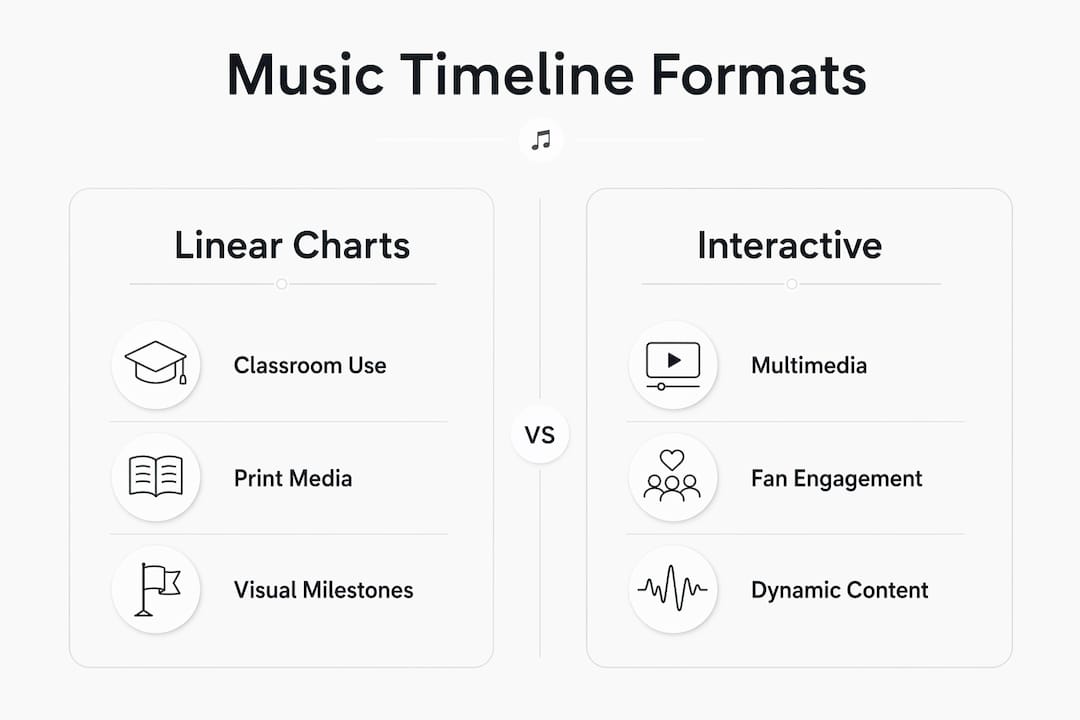
Music timelines appear in several distinct formats, each suited to a different purpose and audience.
| Format | Best use | Key feature |
|---|---|---|
| Horizontal linear chart | Classroom instruction and print media | Simple left-to-right chronology |
| Vertical scrolling timeline | Digital articles and mobile displays | Easy navigation on small screens |
| Genre genealogy map | Research and fan education | Shows branching relationships between styles |
| Concert chronology | Fan engagement and venue archives | Captures setlists, venues, and audience moments |
| DAW project timeline | Music production and studio work | Tempo-locked grid for audio and MIDI |
| Interactive multimedia timeline | Museums and online platforms | Embeds photos, audio, and video |
Interactive music timelines use multimedia such as photos, audio, and video to create engaging educational and fan experiences. Museum exhibits like permanent rock history installations use this format to let visitors move through decades of music by clicking or physically walking through a space. The experience is closer to attending a concert than reading a textbook.
Static timelines still have real value in education and print. A well-designed horizontal chart showing major music technology milestones, from the 1931 launch of the 33 1/3 vinyl record player to the 1983 Yamaha DX7 to the 1994 Yamaha ProMix 01 mixer, gives students an immediate sense of how quickly production technology accelerated across the 20th century. That acceleration directly explains why recorded music sounds so different decade by decade.
How to create and interpret a music timeline effectively
Building a music timeline that actually teaches something requires more than collecting dates. The structure and scope decisions you make before you start determine whether the result is useful or just decorative.
- Define your scope first. A timeline covering all of music history needs different granularity than one covering a single artist’s career. Decide whether you are mapping centuries, decades, or years before you place a single event.
- Choose your anchor events carefully. Every timeline needs fixed points that most readers will recognize. For a genre timeline, those anchors might be the first commercial recording of a style. For a career timeline, they are debut releases and major label shifts.
- Add contextual annotations. Dates without context are just numbers. A note explaining that the 1994 Yamaha ProMix 01 was the first affordable digital mixer tells readers why that date matters to home recording culture.
- Layer in the connections. Draw lines or use color coding to show when one genre influenced another, or when a producer worked across multiple artist timelines simultaneously.
- Avoid oversimplification. The biggest mistake in music timeline creation is forcing clean breaks between eras. Jazz did not end when rock began. Both continued to develop in parallel, and their interaction produced soul, funk, and fusion.
Pro Tip: When interpreting an existing music timeline, look for what is missing as much as what is included. Gaps often reveal editorial bias or geographic blind spots, especially in timelines that focus on American and British music while omitting African, Latin, and Asian contributions.
Arteest solves the oversimplification problem by building artist pages that display entire careers chronologically, with every release, collaboration, and milestone in sequence. That structure makes it easy to see the full arc of a career without editorial shortcuts.
Key takeaways
A music timeline is most valuable when it explains why music changed, not just when events occurred.
| Point | Details |
|---|---|
| Core definition | A music timeline arranges musical events chronologically to reveal patterns, connections, and turning points. |
| Historical value | Timelines covering nine major eras show how genres overlap and borrow from one another across centuries. |
| Professional use | In DAWs, timelines function as master clocks; in career management, they layer releases, eras, and live records. |
| Format variety | Formats range from static horizontal charts to interactive multimedia maps used in museums and online platforms. |
| Creation best practice | Define scope, anchor with recognized events, annotate context, and avoid forcing clean breaks between eras. |
Why music timelines changed how I listen
I spent years studying music the way most people do: album by album, artist by artist, with no real sense of the larger picture. The first time I worked through a proper genre genealogy map, tracing soul back through gospel and blues and then forward into hip-hop and R&B, something clicked that no amount of listening alone had produced. The music I already loved made more sense. The music I had ignored suddenly had a reason to exist.
What I have found is that most people underestimate the emotional dimension of a well-built timeline. They think of it as a study tool, something for students or researchers. But a timeline that captures a live artist’s career, including the tours, the lineup changes, the stylistic risks that paid off and the ones that did not, functions more like a biography than a chart. It creates empathy for the creative process in a way that a single album never can.
The other thing I have learned is that timelines expose your own blind spots faster than anything else. When I first mapped out the timeline of music genres I actually listened to, the gaps were embarrassing. Entire continents of music were missing. That map became a listening list, and that listening list changed my understanding of what music is and where it comes from.
The most honest thing I can say about music timelines is this: they do not just organize information. They change the questions you think to ask.
— Jorel
Arteest and the art of music discovery
Arteest is a premium music discovery platform built around chronological career data for thousands of artists, bands, record labels, producers, and engineers.
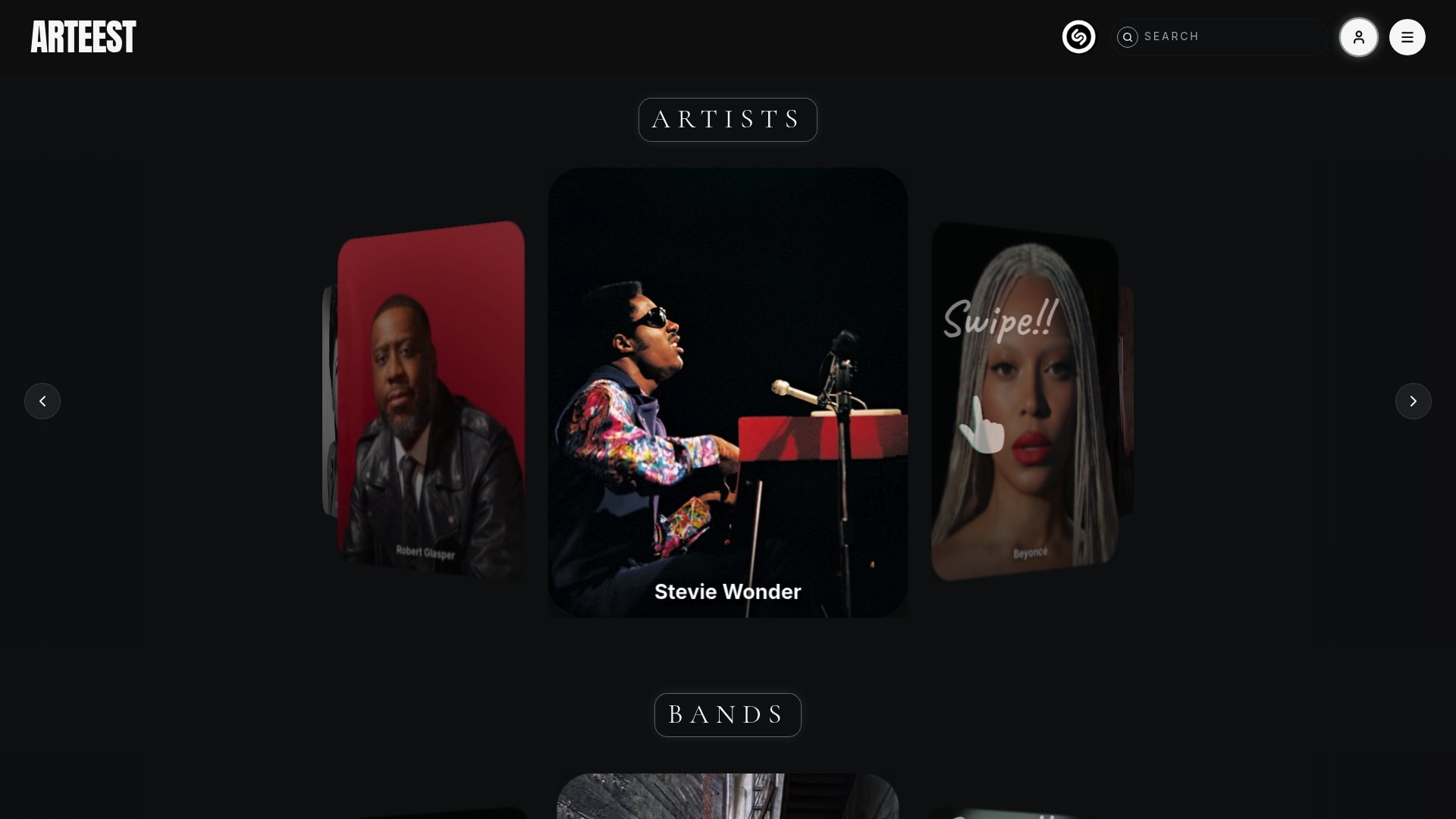
Every artist page on Arteest displays a complete career timeline, from debut releases through the most recent work, so you can see exactly how an artist developed over time. Personal profile pages let you build collections and bins of favorite artists, create filterable lists, and share custom lists as PNG or MOV files directly to social media or by text. Whether you are tracing the career of a jazz legend like Art Taylor or following a contemporary act, Arteest gives you the chronological depth to understand the full story. Explore the full artist directory and start building your own music timeline today.
FAQ
What is a music timeline?
A music timeline is a chronological arrangement of musical events, milestones, and developments along a linear axis. It organizes genre origins, technological inventions, and artist career moments to show how music evolves over time.
What is a live music timeline?
A live music timeline documents a performer’s concert history in chronological order, capturing setlists, venues, stage technology, and audience moments. It functions as a narrative record of how an artist’s live performance evolved across their career.
How do music timelines work in education?
Music timelines act as scaffolds that help students avoid misconceptions about genre isolation and see the interconnected nature of musical styles. They map turning points like the invention of music printing or the rise of digital streaming to explain why music changed, not just when.
How do I create a music timeline?
Start by defining your scope, then select anchor events that most readers will recognize, add contextual annotations to each date, and layer in connections between events. Avoid forcing clean breaks between eras, since most musical periods overlap and influence one another simultaneously.
What formats do music timelines come in?
Music timelines appear as horizontal linear charts, vertical scrolling displays, genre genealogy maps, concert chronologies, DAW project grids, and interactive multimedia installations. Each format suits a different audience and purpose, from classroom instruction to professional music production.